

How to Improve Lead Conversion in Property Management
Late on a Tuesday night, a renter sends the same tour request to three apartment communities. The first property responds within minutes and schedules a showing. The other two wait until morning.
By then, the prospect already has a tour scheduled.
This happens every day in property management. Generating leads is only half the battle. What happens after someone submits an inquiry determines whether that lead becomes a tour, an application, and eventually a signed lease.
For property managers, improving lead conversion starts with responding faster, following up consistently, and making it easier for prospects to move through the leasing process. Here's how to identify where leads are getting lost and improve conversion across your leasing funnel.
Key takeaways
- Speed wins: answer every inquiry within minutes, day or night.
- A consistent follow-up cadence beats relying on someone remembering.
- Track lead-to-tour and lead-to-lease to find exactly where the funnel leaks.
- AI executes the repetitive steps; your team keeps tours, objections, and closes.
Why property managers lose leads
Lead loss rarely comes from one major mistake. More often, it's a combination of small operational gaps that prevent prospects from moving forward.
1. Slow response times
When a prospect submits an inquiry, they're often contacting multiple properties at once. If your leasing team takes several hours to respond, another property may already have answered their questions and scheduled a tour. The faster your team responds, the better the opportunity to engage prospects while they're actively searching.
2. Inconsistent follow-up
Most prospects won't sign a lease after their first interaction. Some need additional information, others are comparing properties, and many simply get distracted. Without a consistent follow-up process, promising leads can disappear because nobody remembers to reach back out.
3. Missed calls and after-hours inquiries
Leasing inquiries don't follow office hours. Prospects search for apartments in the evenings, on weekends, and during lunch breaks. When calls go unanswered and online inquiries sit overnight, properties miss opportunities to engage renters when they're actively looking.
4. Complicated tour scheduling
Getting a prospect interested is only part of the process — they still need to schedule and attend a tour. Back-and-forth communication, limited availability, and missing confirmations can create unnecessary friction. The longer it takes to schedule a showing, the more opportunities there are for a prospect to lose interest.
5. Missing application follow-up
A prospect tours the property, likes the apartment, and starts an application. Then nothing happens. Without follow-up, reminders, and clear next steps, applicants can stall or choose another property. Leasing teams need visibility into every stage of the funnel, not just the initial inquiry.
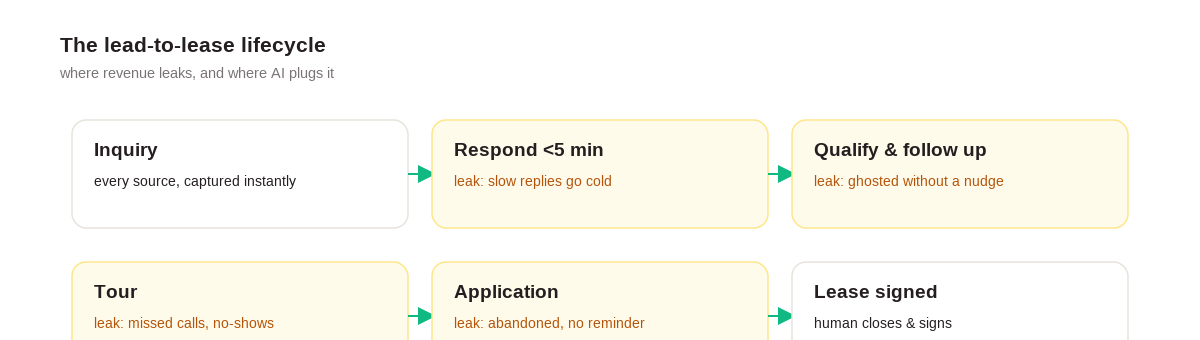
6 ways to improve lead conversion
Improving lead conversion doesn't necessarily require generating more leads. Start by getting more value from the inquiries your property already receives.
1. Respond to every inquiry quickly
Speed should be one of the first metrics property managers monitor. Establish a response-time target and make sure every inquiry receives an acknowledgment, even outside normal business hours. A fast first response gives your team the opportunity to answer questions, establish interest, and move the prospect toward a tour.
2. Create a consistent follow-up process
Don't rely on leasing agents to remember every prospect who hasn't responded. Build a follow-up cadence that keeps your property in front of interested renters without overwhelming them. For example:
- Immediately: Send an initial response to the inquiry.
- Same day: Follow up if the prospect hasn't responded.
- Day 2: Check whether they have questions or want to schedule a tour.
- Day 4: Share relevant property information or available units.
- Day 7: Send another follow-up with a clear next step.
Adjust the frequency based on prospect engagement and stop outreach when someone opts out or is no longer interested.
3. Make scheduling a tour easy
Reduce the number of steps between an inquiry and a completed showing. Offer available tour times, provide clear instructions, and send automatic confirmations and reminders. Where possible, allow prospects to schedule tours without waiting for a leasing agent to coordinate every detail.
4. Capture missed calls and after-hours leads
Make sure inquiries don't disappear simply because your office is closed. Use call handling, missed-call follow-up, and automated messaging to capture prospect information and provide an immediate next step. Every phone call, website inquiry, and listing-platform lead should enter the same follow-up process.
5. Follow up after tours
A completed tour doesn't automatically mean a prospect is ready to apply. Send a follow-up message thanking them for visiting, answering outstanding questions, and providing a clear application link. This is also an opportunity to understand objections and determine whether another unit or lease option might be a better fit.
6. Track conversion at every stage
If you only measure the number of leads received, you won't know where your leasing process is breaking down. Track how many prospects move from inquiry to tour, tour to application, and application to signed lease. This helps identify whether your biggest problem is slow response times, poor tour attendance, or application drop-off.
How AI leasing automation improves lead conversion
Many lead conversion problems aren't caused by a lack of effort — they're caused by the volume of repetitive tasks leasing teams need to manage. Responding to inquiries, sending follow-ups, answering routine questions, scheduling tours, and reminding applicants all take time.
AI leasing automation helps execute these workflows consistently, including outside normal business hours. Here's where AI can help:
- First response: Respond to new inquiries through text and email within minutes.
- Lead follow-up: Send consistent follow-up messages based on prospect activity and your team's configured cadence.
- After-hours coverage: Engage prospects when leasing offices are closed.
- Tour scheduling: Coordinate available showing times and send confirmations.
- Post-tour communication: Follow up with prospects and provide application links.
- Application follow-up: Remind prospects about outstanding steps and route applications through the appropriate screening process.
The important distinction is that AI should execute repetitive workflows, not replace the judgment of your leasing team. Your team should still handle property tours, complex questions, objections, and final leasing decisions.
How RentBamboo helps property managers convert more leads
RentBamboo works alongside existing property management systems to automate leasing communication from the first inquiry through tour scheduling and application follow-up. Instead of relying on leasing agents to manually respond to every prospect, RentBamboo helps teams maintain consistent communication through AI text, email, and phone workflows.
At Bay Vista Apartments, RentBamboo helped process 410 leads over 90 days, contributing to 21 move-ins and $22,050 in monthly rental revenue. The property also reduced lead response times to under five minutes.
For property managers, the goal isn't simply to respond to more messages — it's to make sure fewer opportunities fall through the cracks between the initial inquiry and a signed lease.
Manual vs. AI-assisted leasing
| Leasing activity | Manual process | AI-assisted process |
|---|---|---|
| First response | Agent responds when available | Automated responses around the clock |
| Follow-up | Depends on agent availability | Consistent configured follow-up |
| Missed calls | Voicemail and manual callbacks | Automated call handling and follow-up |
| Tour scheduling | Manual coordination | Automated scheduling and reminders |
| Post-tour follow-up | Agent sends individual messages | Automated follow-up workflows |
| Applications | Manual reminders | Automated reminders and workflow support |
| Reporting | Data across multiple systems | Centralized activity and conversion tracking |
How to measure lead conversion
To improve leasing performance, property managers need to understand how effectively their team turns inquiries into signed leases. Start with these five metrics:
Lead-to-tour conversion rate — Tours completed ÷ total leads received × 100. Measures how effectively your team turns inquiries into property visits.
Tour-to-application conversion rate — Applications received ÷ completed tours × 100. Measures how effectively property tours generate application interest.
Application-to-lease conversion rate — Signed leases ÷ applications received × 100. Helps identify how many applicants ultimately become residents.
Lead-to-lease conversion rate — Signed leases ÷ total leads received × 100. Measures overall leasing funnel performance.
Time-to-first-response — The average time between receiving an inquiry and sending the first response. This helps identify whether slow communication is hurting your conversion rates.
Track these metrics by property and lead source. That way, you can identify which marketing channels generate the strongest prospects and where your leasing process needs improvement.
FAQ
Final thoughts
Generating more leads doesn't always mean signing more leases. Property managers need a consistent process for responding to inquiries, following up with prospects, scheduling tours, and moving applicants toward a decision. The more friction you remove from the leasing process, the more opportunities your team has to convert the leads already coming through the door.
RentBamboo helps property management teams automate these workflows alongside their existing PMS, giving leasing teams more time to focus on tours, relationships, and closing leases. Schedule a RentBamboo demo.
See the AI leasing layer in action
Book a demo to see how RentBamboo automates follow-up, tours, and resident ops alongside your PMS.