

How to Reduce Resident Turnover and Improve Resident Retention
A resident submits their 30-day notice on a Tuesday morning. Now your team has a vacant unit to prepare, market, show, and lease again. There's lost rental income, make-ready expenses, and additional work for your leasing team.
But what if that resident could have been retained with a renewal conversation three months earlier?
Resident turnover is one of the biggest operational expenses for property management companies. While some move-outs are unavoidable, many happen because of problems that could have been addressed earlier.
From slow maintenance responses to poor communication and missed renewal opportunities, small frustrations can eventually push good residents toward another property.
The key to reducing resident turnover is identifying those problems before they become reasons to leave.
Key takeaways
- Turnover stacks vacancy, make-ready, marketing, and leasing labor onto every move-out.
- Residents usually leave over neglected maintenance, poor communication, and missed renewals — not rent alone.
- Start renewals 60–90 days out, answer maintenance fast, and communicate consistently.
- AI automates renewals, resident comms, and follow-up so nothing slips through.
Why resident retention matters for property managers
Keeping an existing resident is generally less expensive than finding, screening, and leasing to a new one.
Every move-out creates several potential costs:
- Vacancy loss: Rental income stops while the unit is unoccupied.
- Turnover expenses: Cleaning, repairs, painting, and make-ready work add up.
- Marketing costs: Your team must advertise the vacancy and generate new leads.
- Leasing labor: Staff spend time answering inquiries, scheduling tours, and processing applications.
- Operational disruption: Maintenance and onsite teams must coordinate the transition.
Consider a property charging $1,500 per month in rent. If a unit sits vacant for 30 days, that's $1,500 in lost rental income alone, before accounting for make-ready costs, marketing, and leasing labor.
Multiply that across several units, and turnover becomes a significant financial burden.
Improving resident retention helps protect occupancy, reduce operating expenses, and create more predictable rental income.
Why residents choose not to renew their leases
Residents rarely leave because of just one interaction. More often, dissatisfaction builds over time. Here are some of the most common reasons residents decide to move.
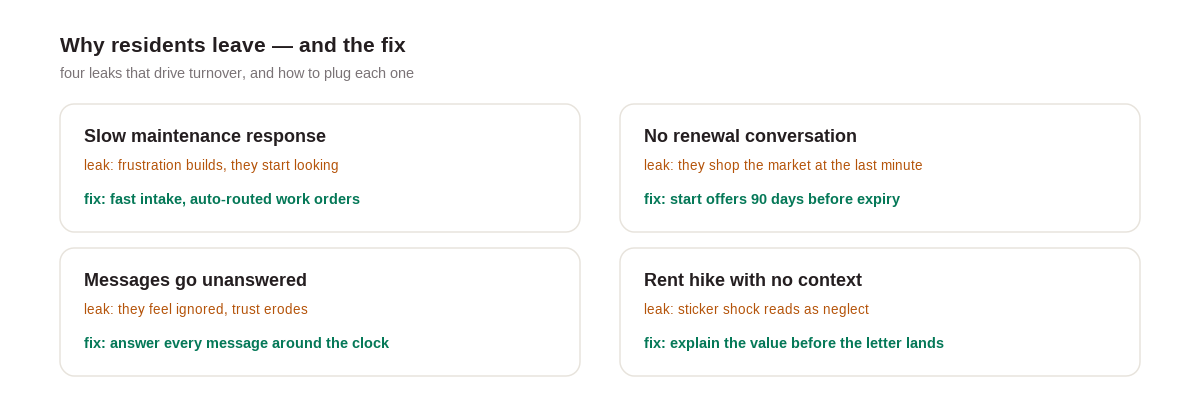
1. Poor maintenance experiences
Maintenance is one of the most visible parts of the resident experience. When a maintenance request goes unanswered for days, residents can feel ignored. Even when a repair requires additional time, a lack of communication makes the experience worse.
Property managers should prioritize acknowledging maintenance requests quickly, providing realistic repair timelines, communicating delays, and following up after work is completed. Residents don't expect every issue to be fixed immediately, but they do expect someone to take responsibility.
2. Lack of communication
Residents shouldn't have to chase their property manager for answers about basic questions. Unanswered emails, delayed text responses, and unclear updates create frustration over time. Consistent communication helps residents feel supported and gives property managers an opportunity to address concerns before they escalate.
3. Missed renewal opportunities
One of the biggest mistakes property managers make is waiting until the lease is almost over to discuss renewal. By that point, residents may already be comparing other properties, researching moving costs, or scheduling tours. Starting renewal conversations 60–90 days before lease expiration gives your team more time to understand resident concerns, discuss pricing, and secure commitments.
4. Unexpected rent increases
Rent is naturally one of the biggest factors residents consider when deciding whether to renew. However, price isn't the only consideration — residents also evaluate maintenance quality, amenities, location, communication, and the overall value of living at the property. Communicating renewal pricing early and explaining available options can make the process more transparent and reduce surprises.
5. Feeling like just another lease
Residents want to feel that their property management team cares about their experience. A lack of follow-up after maintenance requests, ignored complaints, and generic communication can make even a well-maintained property feel impersonal. Small interactions throughout the lease can have a meaningful impact on whether someone chooses to stay.
6 strategies to reduce resident turnover
Improving retention doesn't require a complete overhaul of your property management operations. It starts with creating consistent processes that address resident needs throughout the lease.
1. Start renewal conversations 60–90 days early
Don't wait for a lease expiration notice to begin communicating with residents. Start outreach 60–90 days before expiration to give residents time to consider their options. Your renewal process should include:
- Identifying upcoming lease expirations.
- Sending renewal offers early.
- Following up with residents who haven't responded.
- Addressing questions about pricing and lease terms.
- Tracking renewal decisions and outstanding responses.
The earlier your team starts, the more opportunities you have to retain residents before they begin looking elsewhere.
2. Improve maintenance response times
A responsive maintenance team can make a significant difference in resident satisfaction. Create clear expectations for acknowledging requests, assigning technicians, and communicating repair updates. It's also important to distinguish between emergency maintenance and routine requests so urgent issues receive the appropriate attention. Even when a repair cannot be completed immediately, keeping residents informed helps build trust.
3. Communicate consistently throughout the lease
Resident communication shouldn't only happen when rent is due or a lease is expiring. Regular communication helps property managers stay connected with residents and identify potential issues earlier. Consider implementing:
- Move-in follow-ups.
- Maintenance completion confirmations.
- Community announcements.
- Lease expiration reminders.
- Renewal check-ins.
- Payment reminders.
- Resident satisfaction surveys.
The goal is to create a consistent resident experience rather than communicating only when something needs attention.
4. Make the renewal process simple
Complicated renewal processes create unnecessary friction. Residents should be able to understand their renewal options, review pricing, ask questions, and complete the necessary paperwork without excessive back-and-forth. Make renewal offers easy to access and provide clear instructions for accepting or declining. The fewer obstacles residents encounter, the easier it is for them to make a decision.
5. Track resident satisfaction and recurring complaints
Property managers should look for patterns rather than treating every complaint as an isolated incident. For example, repeated maintenance complaints about the same building, recurring communication issues, or negative feedback about amenities could indicate a larger operational problem. Track resident feedback, maintenance trends, and unresolved complaints to identify properties or processes that need attention. Addressing recurring problems can prevent them from affecting additional residents.
6. Identify at-risk residents before they move out
Not every resident who is unhappy will submit a complaint. Some will quietly start looking for another apartment and only notify your team once they've made a decision. Pay attention to warning signs such as:
- Repeated unresolved maintenance requests.
- Negative resident feedback.
- Frequent complaints.
- Unanswered renewal offers.
- Communication breakdowns.
- Consistent payment difficulties.
These signals give your team an opportunity to reach out, understand the situation, and potentially resolve the issue before the resident decides to leave.
Build a proactive resident retention timeline
One of the easiest ways to improve resident retention is to establish a consistent communication schedule throughout the lease.
| Timeline | Recommended action |
|---|---|
| Move-in | Welcome message and move-in follow-up |
| 30 days after move-in | Check resident satisfaction |
| Throughout lease | Maintenance updates and resident communication |
| 90 days before expiration | Begin renewal outreach |
| 60 days before expiration | Send renewal offer and follow up |
| 30 days before expiration | Confirm renewal decision and next steps |
| Move-out | Collect feedback and identify improvement opportunities |
This process helps prevent renewal conversations from becoming last-minute administrative tasks. It also gives property managers multiple opportunities to identify concerns throughout the resident lifecycle.
How AI automation helps improve resident retention
One challenge for property management teams is that resident communication doesn't stop when the office closes. Renewal reminders, maintenance questions, payment follow-ups, and everyday resident requests continue coming in after hours and on weekends. When teams are already managing leasing, maintenance, and daily operations, it's easy for important follow-ups to get missed.
AI automation can help property managers maintain consistent communication without requiring employees to handle every interaction manually. For example, AI can:
- Automate renewal outreach: Identify upcoming lease expirations, send renewal reminders, and follow up with residents who haven't responded.
- Answer resident questions: Handle routine questions about property information, policies, and common requests.
- Support delinquency workflows: Send configured payment reminders and follow-up messages.
- Improve communication coverage: Respond to resident inquiries outside normal office hours.
- Keep workflows organized: Help ensure resident interactions and follow-ups are tracked.
For property management teams managing hundreds or thousands of units, keeping up with every resident interaction can become difficult. Renewal reminders get missed, routine questions pile up, and follow-ups slip through the cracks. This is where platforms like RentBamboo can help — RentBamboo works alongside your existing property management software to automate resident communication, renewal outreach, and delinquency follow-ups, helping teams stay proactive without adding more manual work.
Instead of waiting for residents to reach out with a problem or letting renewal opportunities slip by, property managers can maintain consistent communication throughout the resident lifecycle. AI doesn't replace the need for property managers or onsite teams — it helps them stay on top of repetitive communication so they can focus on situations that require human judgment.
FAQ
Final thoughts
Reducing resident turnover starts long before a resident submits their notice. Property managers who prioritize maintenance, communicate consistently, and start renewal conversations early have more opportunities to identify problems and retain good residents. The biggest improvement often comes from building better processes, not simply working harder.
Want to automate resident communication and renewals? RentBamboo helps property management teams manage resident communication, automate renewal outreach, and streamline delinquency follow-up while working alongside their existing property management software. Book a RentBamboo demo.
See the AI leasing layer in action
Book a demo to see how RentBamboo automates follow-up, tours, and resident ops alongside your PMS.